
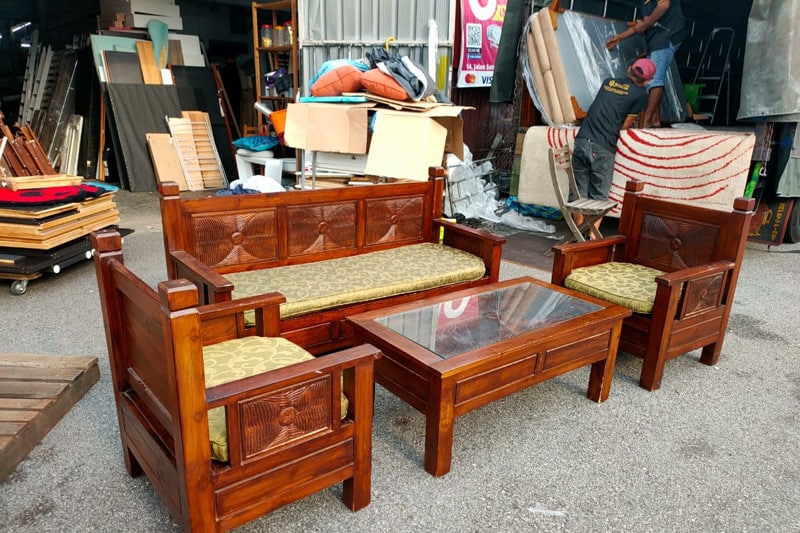
Paint gives a new life to wooden furniture and completely transforms the way it looks. However, we often find it hard to determine which type of paint is best for wooden furniture.
Many people ask us, can you use emulsion on wooden furniture?
In this article, we will show you if it’s okay to use emulsion on wood furniture, which emulsion to use, where and how you can apply it, and much more.
Table of Contents
What is an emulsion?
An emulsion is water-based paint that contains acrylic or vinyl. It is commonly used on interior ceilings and walls. Emulsion paints are available in a variety of colors and finishes.
Can you use emulsion on wooden furniture?
Yes, you can use emulsion on wooden furniture. However, it should not be your first choice because emulsion paints are water-based and they have poor durability when applied to wood.
You can use emulsion on interior wooden furniture because durability is not a big issue here.
For exterior wood furniture, you should use a more robust and more durable paint that can withstand rough weather conditions and heavy use. Always make sure to prepare the wood surface before applying emulsion to it.
Where to use emulsion?
Different wooden furniture items in your house are used for different purposes. Let’s see which one of them can be painted with emulsion.
Can you use emulsion on outdoor furniture?
No, we don’t recommend using emulsion on outdoor furniture. It’s because emulsion on wood is not much durable.
Outdoor furniture is often subjected to heavy use and rough weather conditions. If you will use emulsion on outdoor furniture, the emulsion will start peeling off. As a result, your furniture item will be left unprotected and its quality will start degrading.
You should use a more durable and wood-specific paint for outdoor furniture.
Can you use emulsion on indoor furniture?
Yes, you can use emulsion on indoor furniture.
The reason is that indoor furniture mostly remains in a single spot and it is also not exposed to extreme weather conditions. Therefore, you can use emulsion on indoor paint because durability is not an issue here.
Can you use emulsion on wood paneling?
Yes, you can use emulsion on wood paneling as it is a very suitable option.
The emulsion will give a smooth and glossy finish to the wood paneling and on top of that, it is very easy to apply.
Can you use emulsion on wooden doors?
No, you should not apply the emulsion on wooden doors.
The reason is that emulsion on wood is not very durable & doors are frequently used daily.
As a result, the emulsion starts peeling off and leaves the door exposed.
Can you use emulsion on varnished wooden furniture?
Yes, you can use emulsion on varnished wooden furniture. However, it won’t stick to the surface properly.
That is why you should sand the varnished wooden furniture before applying emulsion to it.
Can you use emulsion on bare wood furniture?
Yes, the emulsion can be used on bare wood furniture.
But, we recommend you prepare the wood first before applying emulsion to it. This way you will get a long-lasting coating.
Can you use emulsion on wooden floors and stairs?
No, you should not use emulsion of wooden floors.
The reason is that wooden floors and stairs have to deal with excess foot traffic 24/7 throughout the year. The emulsion coating will start peeling off because it is not very durable.
You need to use a more durable and wood-specific paint for this purpose.
Can you apply the emulsion on wooden furniture as an undercoat?
Yes, you can use emulsion for adding an undercoat to your wooden furniture.
Although a professional won’t do it because it gives an unimpressive finish, if you have only emulsion paint available, you can use it for an undercoat.
How to use emulsion on wooden furniture?
Here are the steps you need to follow for applying emulsion on wooden furniture:
1. Prepare the wood
If the wood surface is covered with dirt, the emulsion won’t be able to stick to it for longer.
This is why you need to prepare the wood before applying emulsion to it.
Take a dry or slightly damp cloth and wipe the surface of the furniture to remove all the dust and dirt from it.
After that, you can use fine-grit sandpaper on the furniture.
2. Fill the holes
If there are notable holes or cracks present on the surface of your furniture, use good-quality filler to cover them.
It will help you get a smooth finishing. Otherwise, the holes and cracks will mess up the paint job.
3. Apply primer on wood
After cleaning the wood and filling the cracks and holes, it is time to apply a primer.
The primer forms an even and smooth layer on the surface of the wood so the emulsion can stick to it well.
If you are low on budget, you can even use emulsion as a primer. All you have to do is to thin the emulsion paint by adding an equal amount of water in a bucket of 5-gallon size.
Whatever you choose, make sure to apply primer thoroughly on the entire surface of wooden furniture.
Now, wait for the primer to dry completely.
4. Apply the emulsion layer
Once the primer has completely dried, now you use a paintbrush to apply the emulsion to the wooden furniture.
If the emulsion paint seems too thick, you can use a 70:30 ratio of paint to water.
If you are using emulsion paint as an undercoat, you should apply one layer only. But if you want to use emulsion for the top coat, you should apply double or triple layers for better results.
5. Seal the emulsion (optional)
After the emulsion paint has dried, you have one more option and that is to seal the emulsion.
You can do the sealing if you need a durable and shiny finishing. Sealing will also save the emulsion layer from cracking, peeling off, and bubbling. It is ideal for those wooden furniture items that are likely to absorb moisture.
Apply a layer of sealer and wait at least 2 hours for it to dry and then apply another layer of sealer. It will make the surface waterproof as well.